Stormwater
Stormwater runoff results from that portion of rainfall or snowmelt that plants do not take up, soak into the ground or evaporate. It is of primary concern to residents for several reasons: it replenishes flows in rivers and streams and maintains lake levels. It can also be cause for concern: it carries pollutants and sediments to lakes and streams, erodes the ground surface and stream banks, and, in excess, causes flooding, which can damage property and result in injury or even loss of life. It is in the interest of every community to manage its stormwater runoff to protect its residents' health, welfare, and safety and preserve the natural resources.
The Water Resources Management Commission was formed in 2024 by combining the Water Resources Management Commission and the Stormwater Utility Board.
The Commission investigates, plans, and implements programs involving the management of water resources and stormwater infrastructure both within and, insofar as possible, beyond the City's corporate limits. The Commission is responsible for the Stormwater Utility's charge, management, and supervision to protect the public's health, safety, and welfare and meet regulatory and permitting requirements mandated by State and Federal agencies.
Commission Meeting Agendas & Minutes
- Sign up for email updates.
- View past agendas and minutes.
2024 Stormwater Utility Referendum | Related OrdinancesThree ordinances in particular relate to Water Resources issues: |
Stormwater Study Reports
| Water Quality Master PlanStormwater Quality Plan - Main Report |
Additional Information: | |
The Dane County Land & Water Resources Department manages and forecasts the water level of Lake Mendota.
See http://www.infosyahara.org/outlook_wl for the short-term water level history and forecast. When Lake Mendota is forecast to rise above 851.5, the City of Middleton may offer assistance by providing sand, sandbags, and plastic sheeting for use by affected homeowners. Stay tuned for notices on social media or the City’s webpage or contact the Public Works Department at 821-8370. The City encourages residents on the shore of Lake Mendota to invest in reusable flood protection products (such as tubes that can be filled with water), which are easier and faster to deploy than sandbags.
Flood Protection with Sandbags: A Quick Guide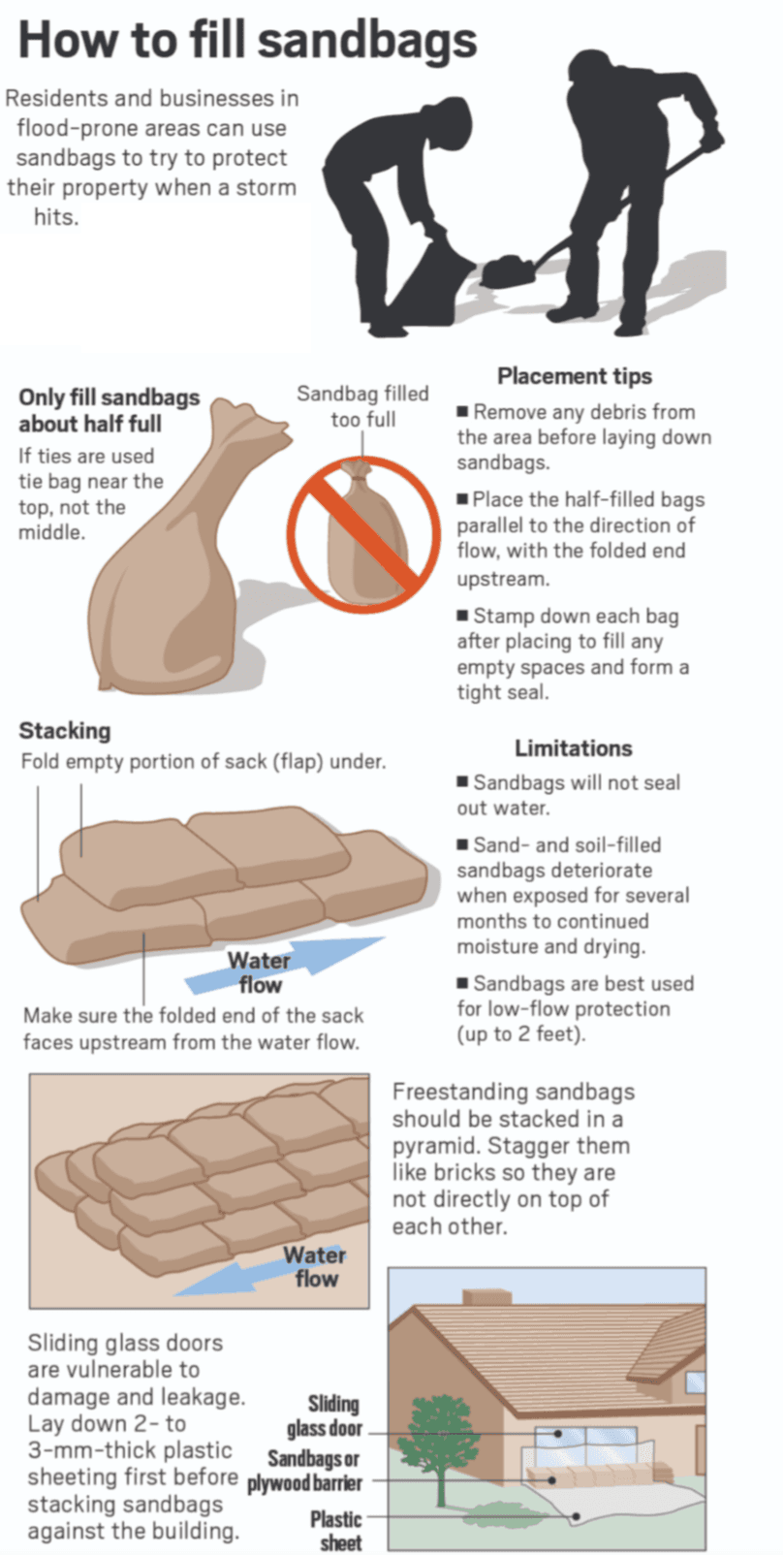
Benefits of Sandbags:
- Create a barrier to redirect floodwater around buildings.
Important Tips:
- Sandbags will leak; have a pump ready to remove water on the dry side.
- Homeowners in flood-prone areas should buy a pump in advance.
Do Not Use:
- Garbage bags
- Feed sacks
Filling Sandbags:
1. Preparation:
-Use gloves for protection.
- Sandbag filling requires two people.
2. Filling Process:
- Person 1: Fold the top of the bag to form a collar and hold it open with feet apart and knees slightly bent.
- Person 2: Carefully shovel sand into the bag.
- Fill bags one-third to one-half full for optimal weight and stacking.
Placement of Sandbags:
1. Setup:
- Clear debris from the placement area.
- Fold the unfilled end of the bag into a triangle or flatten if tied.
2. Laying Sandbags:
- Place bags lengthwise and parallel to the water flow, with the open end facing against the flow.
- Tuck flaps under and ensure the unfilled portion is under the sandbag's weight.
- Stagger and stamp each bag to create a tight seal.
Building Higher Barriers (Pyramid Placement):
1. Method:
- Place sandbags in a pyramid by alternating between crosswise and lengthwise.
- Overlap and stagger joints, tucking in loose ends.
- For unsupported layers over three high, use pyramid placement for stability.
The Middleton Stormwater Utility has faced recurring issues with aquatic mammals, namely beavers and muskrats, that have caused structural damage to infrastructure and impeded proper water flow in Confluence Pond. Beavers are known as our native ecosystem engineers, building dams from vegetation, sediment, and other materials they find. However, this natural behavior can have negative consequences when they interact with engineered facilities, such as Middleton's stormwater basins. These impediments can increase flooding risk, pose a hazard to those who walk through the conservancy's vegetated areas, and lead to costs for retroactive debris removal and repairs to damage.
To proactively address these recurring problems, the SWU plans to hire a trapper to remove and relocate these animals. This work will be done in accordance with all WDNR standards and regulations by a licensed trapper, with the intent of live-trapping and appropriately relocating the animals to a natural area less susceptible to negative impacts from their innate behaviors.
Wisconsin Pollution Discharge Elimination System (WPDES)
The City of Middleton is a member of the Madison Area Municipal Storm Water Partnership (17 central Dane County municipalities, Dane County, and UW-Madison), which submitted a stormwater discharge permit to the Wisconsin Department of Natural Resources. Rather than applying for the permit individually, these municipal entities joined forces to save time, money, and resources. Their website, www.Ripple-Effects.com, has a plethora of information on how residents' daily activities can positively impact Dane County's water resources.
In compliance with the provisions of Chapter 283, Wisconsin Statutes, and Chapters NR 151 and 216, Wisconsin Administrative Code, municipalities in Wisconsin must apply for a stormwater permit to discharge stormwater through a separate storm sewer system into the State's waters. The permit requires that municipalities submit to WisDNR an annual report of activities aimed at complying with the permit's requirements.
Links to copies of the WPDES reports for the City of Middleton are provided here.
Facility Inspection Report Forms
Support Documents
Adopt-A-Storm Drain Program
The City of Middleton is now partnering with Dane County in the Adopt-A-Storm Drain Program. Click here to learn more!
Splashy Sam kids' book (Sam adopts a storm drain)
Report an Illicit Discharge
An illicit discharge is any discharge of a potentially polluting substance directly or through stormwater that reaches a municipal storm sewer, drainage way, wetland, waterbody, or groundwater.
Examples of potential water pollution or illicit discharges:
- Cleaning paint containers or brushes outside
- Grease or other substances leaking from a dumpster
- Oil and chemical spills
- Concrete washout water draining from a construction site
If you see something other than rain or snowmelt draining into a storm drain or a local waterway, please report it using the following link. https://lwrd.countyofdane.com/illicit-discharges
Salt Reduction
The use of de-icing salt on streets, sidewalks, and parking lots, as well as salts discharged from inefficient water softeners, contribute to ever-increasing chloride levels in our lakes and streams. High chloride concentrations adversely affect aquatic life. Some local water wells are also showing increasing levels of salinity.
The Wisconsin Salt Wise Partnership works to reduce salt pollution in our lakes, streams, and drinking water.
- WiSaltWise.com - Visit their website to learn more.
- MMSD's Chloride Reduction Website
- Save Money - Use Less Salt
- State Salt Use
- Homeowners
- Motorists
- Applicators
Related Resources
Dane County's Ripple Effects website contains program information for:
- Leaf Free Streets
- Rain Gardens and Downspout Gardens
- Plant Dane Native Plant Sales
- Rainbarrel Purchases
- Storm Drain Marking and Murals